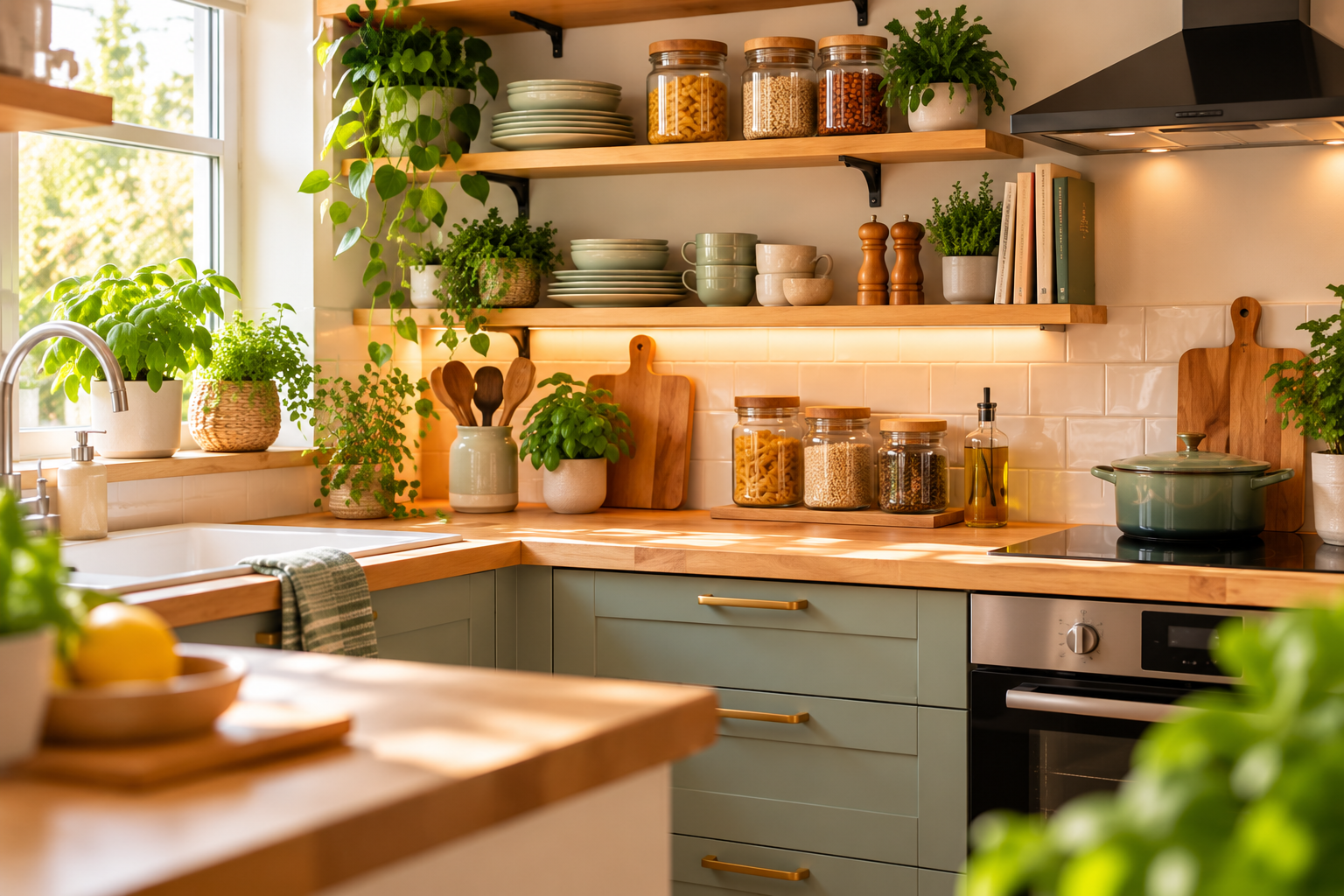
10 Clever Kitchen Storage Ideas for a Small Kitchen
Small kitchens can quickly become cluttered, but simple storage changes can make better use of the space you already have. These 10 practical ideas help you use cupboard height and awkward gaps while keeping worktops and drawers organised. Before choosing additional storage, try rearranging the kitchen with what you already have.
This post contains affiliate links. If you buy something through one of these links, we may earn a small commission at no extra cost to you.
1. Make better use of vertical cupboard space
Kitchen cupboards often have more usable space than they first appear to. The problem is that plates, mugs, tins and food containers tend to occupy the bottom half of a shelf, leaving a large amount of empty space above them.
Shelf inserts can help make use of this unused height by creating an additional storage level inside the cupboard. They can be particularly useful for separating different types of items rather than stacking everything directly on top of one another, making things easier to see and reach.
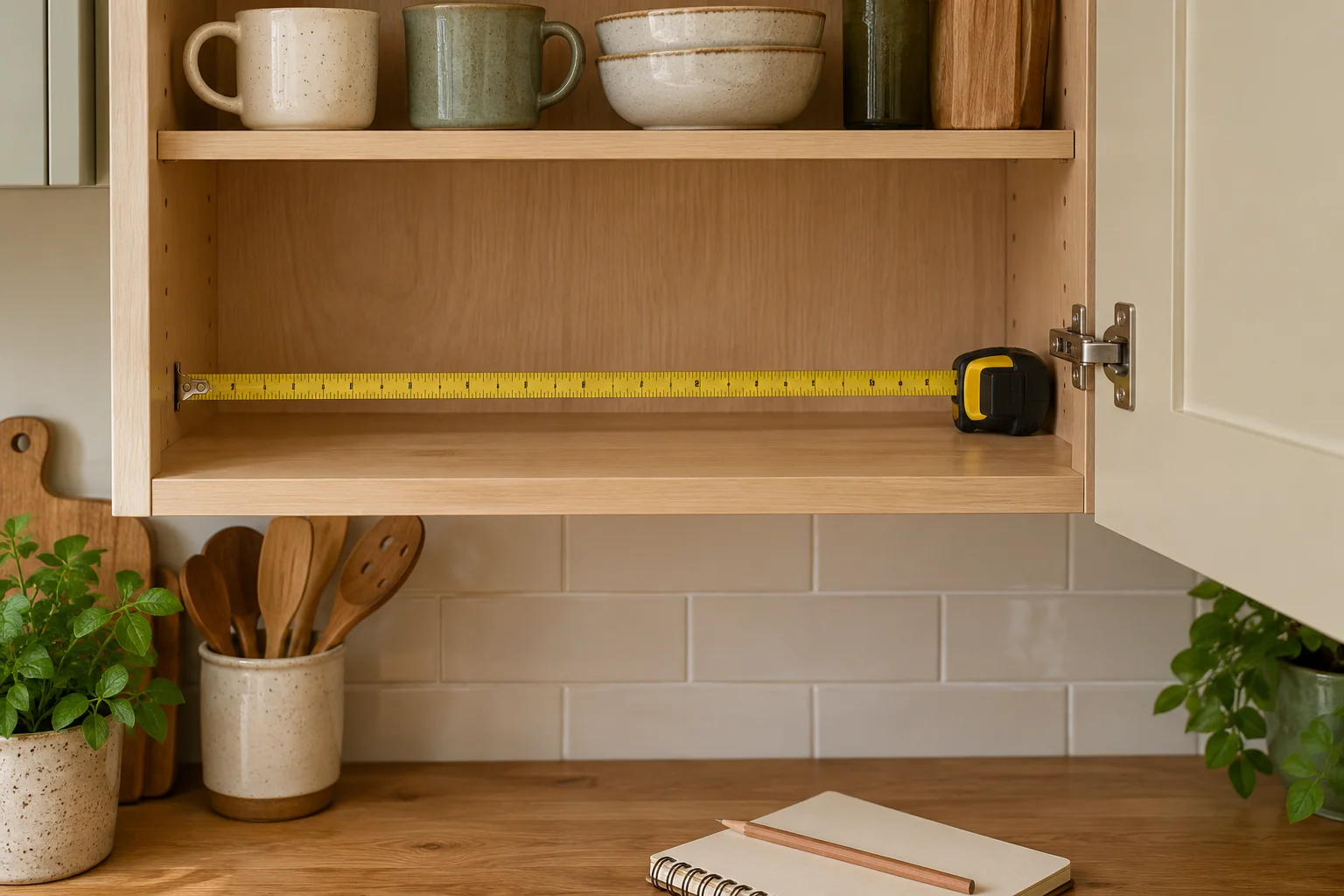
Use a shelf insert when there is spare height above plates or tins that you want to lift out individually. Measure the cupboard opening, shelf depth and usable height, including any hinge intrusion. Our guide to measuring storage spaces shows how to record openings, obstructions and room to retrieve items. Check clearance both below and above the insert. Rearranging an existing adjustable shelf may solve the same problem; try that first and avoid creating a top level you cannot see or reach.
Look for:
- A size that fits comfortably inside your cupboards
- Enough clearance for the items you want to store underneath
- A sturdy design that can support everyday kitchen items
- Shelves that can be stacked or used separately
- A simple design that can be rearranged as your storage needs change
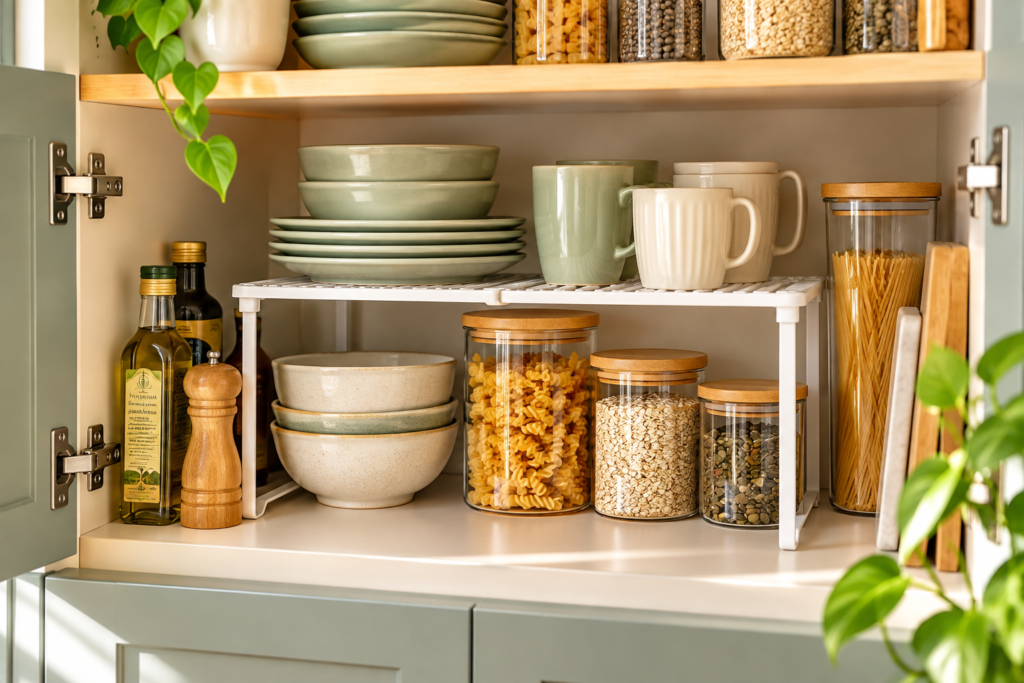
A practical cupboard storage option
Amazon Basics Stackable Kitchen Storage Shelves
Add an extra storage level for plates, cups, tins and other kitchen essentials without using more cupboard space. Use the two metal shelves side-by-side or stacked.
- Useful for:
- Cupboards with unused height.
- Size:
- Approx. 31.6 cm wide × 20.3 cm deep × 11.4 cm high.
- Before buying:
- Measure your cupboard and check the clearance for items underneath.
2. Make use of the space underneath shelves
Kitchen cupboards often have unused space between the items on a shelf and the shelf above. This is particularly common in taller cupboards, where smaller packets, tins and other everyday items may only occupy the bottom half of the available space.
An under-shelf basket can turn some of that empty space into useful storage without requiring another permanent shelf. It can be particularly handy for lightweight items that you want to keep separate and easy to reach.
An under-shelf basket suits lightweight packets or cloths that would otherwise scatter across a shelf. It differs from an insert because it occupies space below the shelf above, rather than standing on the shelf below. Check the shelf thickness, the depth of the supporting arms and whether they prevent the cupboard door closing. Try grouping the same items in an existing shallow container first; a hanging basket is useful only if that still wastes accessible space.
Look for:
- A basket that fits the width and depth of your cupboard
- Enough clearance beneath the shelf for the items you want to store
- Hooks or supports that fit securely over your existing shelf
- A design that can be removed or repositioned easily
- A suitable size and weight capacity for the items you plan to store
3. Make use of the inside of cupboard doors
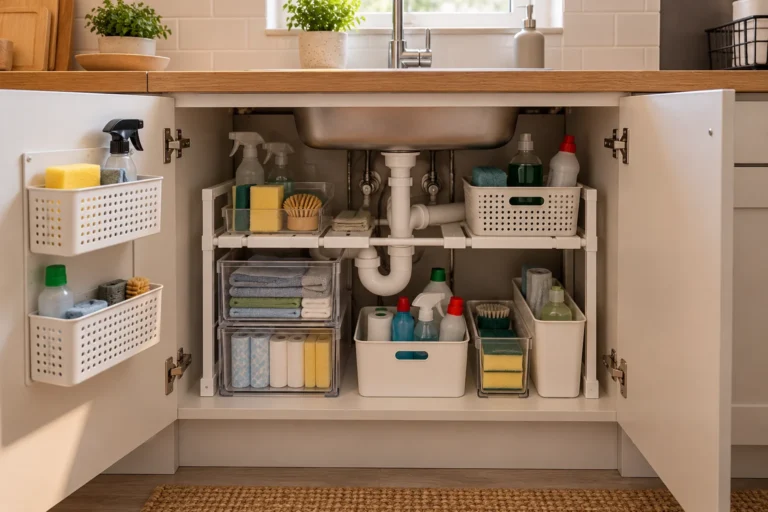
The inside of a kitchen cupboard door is easy to overlook, but it can provide useful storage without taking up any additional shelf or worktop space. A small basket or organiser can be particularly useful for items that tend to get lost towards the back of a cupboard.
Before adding door storage, check that there is enough clearance inside the cupboard for the basket and its contents when the door is closed. It is also worth keeping heavier items on the shelves and using door storage for smaller, lighter everyday essentials.
Close the door slowly with an empty test container held in the proposed position to identify clashes with shelves or hinges. Keep storage clear of the handle fixings and choose a position you can reach comfortably. Adhesive mounts need a compatible clean surface and the maker’s setting time. Avoid assuming a cupboard door will support heavy bottles simply because the basket has room for them.
Look for:
- A size that fits comfortably inside your cupboard door
- Enough clearance for the door to close properly
- Secure fixings suitable for the surface of your cupboard
- A basket deep enough to prevent items from falling out
- Easy access to the items you use regularly
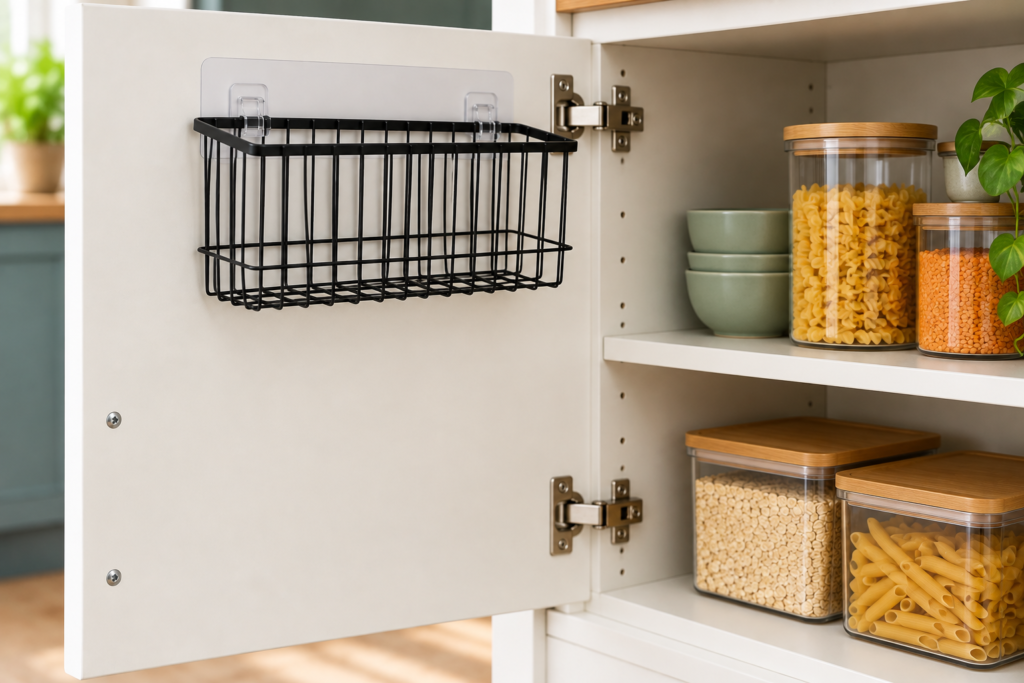
A practical cupboard door storage option
Toplife Cupboard Door Organiser
This shallow basket offers door-mounted storage for smaller kitchen essentials.
- Product details:
- The Toplife cupboard door organiser is a black iron-wire basket measuring approximately 25.9 × 14.5 × 7.9 cm. It uses self-adhesive mounting pads, so it can be fitted to a suitable smooth surface without drilling. Its open design also makes it easy to see what is stored inside.
4. Store pan lids vertically
Pan lids can take up a surprising amount of cupboard space, particularly when they are stacked on top of pans or balanced against the sides of a cupboard. Storing them vertically makes better use of the available space and means you can take out the lid you need without moving everything else first.
A dedicated organiser can also keep different sizes separated rather than allowing them to slide around or become wedged between cookware.
Gather your lids and measure the largest diameter and the space taken by its handle. Test standing them upright in the cupboard before choosing divider spacing. A rack needs enough depth and height for the lids as well as its own frame. Keep the most-used lid nearest the opening, and do not wedge glass lids tightly together. Chopping boards may share the rack if they can be removed without catching lid handles.
Look for:
- Adjustable dividers for different lid sizes
- A compact design that fits inside a cupboard
- Enough height for your largest pan lids
- A stable base that won’t move when removing a lid
- Versatility for storing chopping boards or trays as well
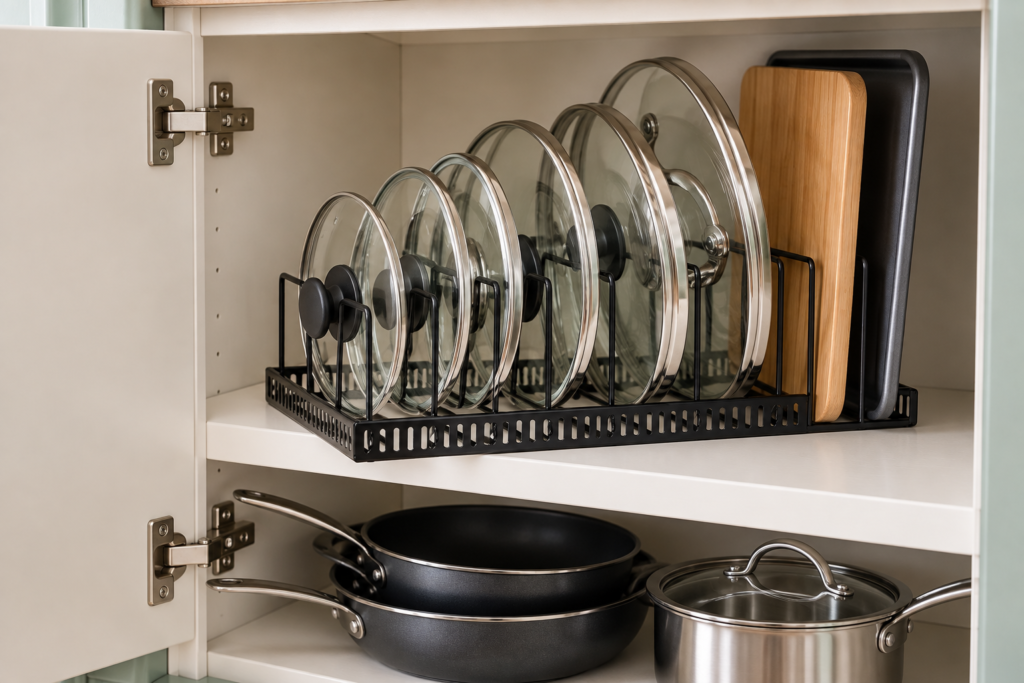
A practical pan lid storage option
Toplife Pan Lid Organiser
Seven adjustable compartments separate lids so each one can be lifted out independently.
- Product details:
- The Toplife Pan Lid Organiser has seven adjustable compartments, with the dividers movable in small increments so the spacing can be adapted to different-sized lids. At approximately 30 × 19 × 13.3 cm, it is designed for use inside kitchen cupboards or on a worktop. The rack can also be used for items such as chopping boards, making it useful if your storage needs change.
5. Hang mugs beneath a cupboard shelf
Mugs can use up a surprising amount of cupboard space, particularly if they are too large or awkwardly shaped to stack safely. If there is unused space between your mugs and the shelf above, an under-shelf holder can turn that empty area into useful storage.
Hanging mugs by their handles also keeps them individually accessible, so you don’t need to lift or rearrange a stack every time you want one.
A mug holder is useful when handles make safe stacking difficult and there is clear space beneath a shelf. Unlike a basket or drawer, it needs room for mugs to hang and swing slightly as you lift them off. Measure shelf thickness and the height of your tallest mug, including its handle. Fewer well-spaced mugs may be more usable than filling every hook; keep regularly used mugs easy to remove without knocking their neighbours.
Look for:
- A design that slides securely over the shelf
- Enough clearance beneath the shelf for your mugs
- Hooks spaced far enough apart to prevent mugs knocking together
- Compatibility with the thickness of your cupboard shelves
- A coated metal finish to help protect the rack
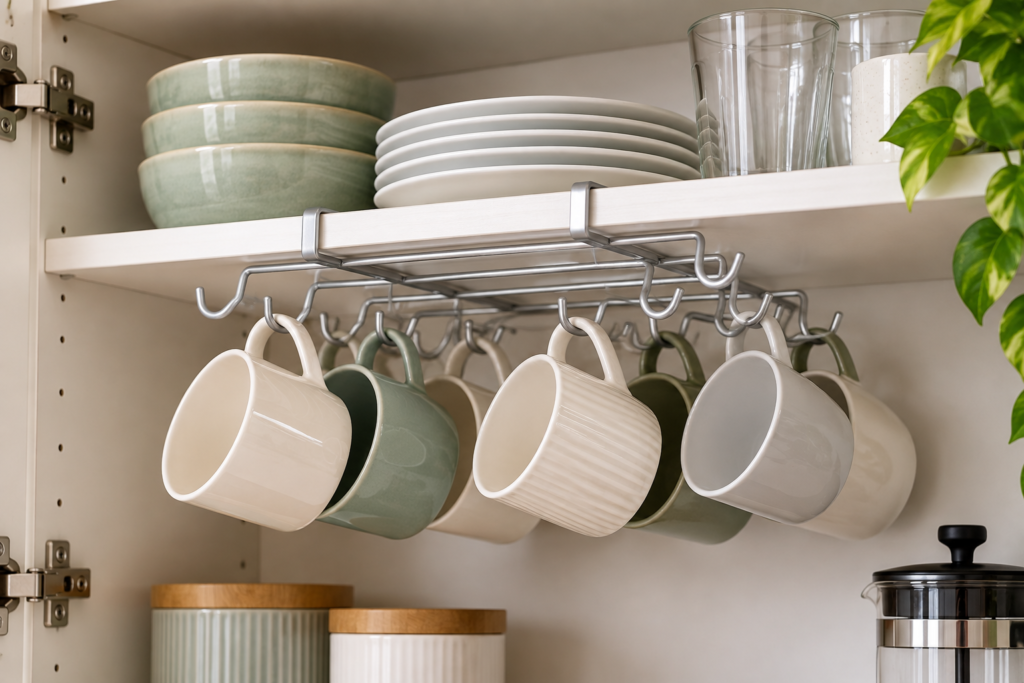
A practical under-shelf mug storage option
Metaltex SpiderMug Shelf Cup Holder
This holder hangs mugs by their handles beneath a cupboard shelf.
- Product details:
- The Metaltex SpiderMug Shelf Cup Holder slides over an existing cupboard shelf and provides hooks underneath for hanging mugs by their handles. According to the listing, it can hold up to 10 cups or mugs and is suitable for shelves up to 2.5 cm thick. Its polytherm-coated metal construction is designed to resist rust and corrosion, and no drilling or permanent fixing is required.
6. Keep everyday sink essentials together
The area around the kitchen sink can easily become cluttered with sponges, brushes, washing-up liquid and other everyday cleaning items. Keeping them together in one organiser makes the worktop look tidier while ensuring the things you use most often are still within easy reach.
A sink caddy can also help separate wet items such as sponges and cloths from bottles and brushes, rather than leaving everything sitting directly around the edge of the sink.
Take everything away from the sink and put back only the cleaning items you use daily. A washable tray you already own can contain bottles, while a separate open holder can keep wet sponges from sitting in pooled water. Leave space to operate the tap and wipe the worktop. Clean and dry the holder regularly; moving clutter into a container is not enough if it makes the sink harder to clean.
Look for:
- Separate areas for brushes, sponges and other small items
- A tray or platform for wet sponges and cloths
- Enough room for the items you use every day
- A design that’s easy to wipe clean
- A compact footprint that doesn’t take over the worktop
7. Make deep cupboards easier to access
Deep kitchen cupboards can offer plenty of storage, but they are not always easy to use. Smaller items often disappear towards the back, while reaching something behind a row of jars, packets or bottles can mean taking half the cupboard out first.
A pull-out organiser turns the cupboard into something closer to a drawer, bringing the contents towards you so that items stored at the back are easier to see and reach. This can work particularly well in lower cupboards used for food, bottles, cleaning supplies or other everyday essentials.
A pull-out basket suits several items that need to travel forwards together, especially in a low, deep cupboard. Measure the clear opening between hinges as well as the cupboard interior, then check space in front for the full extension. Tall bottles must clear the shelf above throughout the movement. Keep heavy contents within the stated load limit and check that the proposed mounting surface meets the maker’s requirements.
Look for:
- Smooth runners that allow the basket to slide out easily
- A size that leaves enough clearance inside your cupboard
- Raised sides to help keep items secure
- A sturdy base for heavier bottles, jars or tins
- Simple installation without major alterations to the cupboard
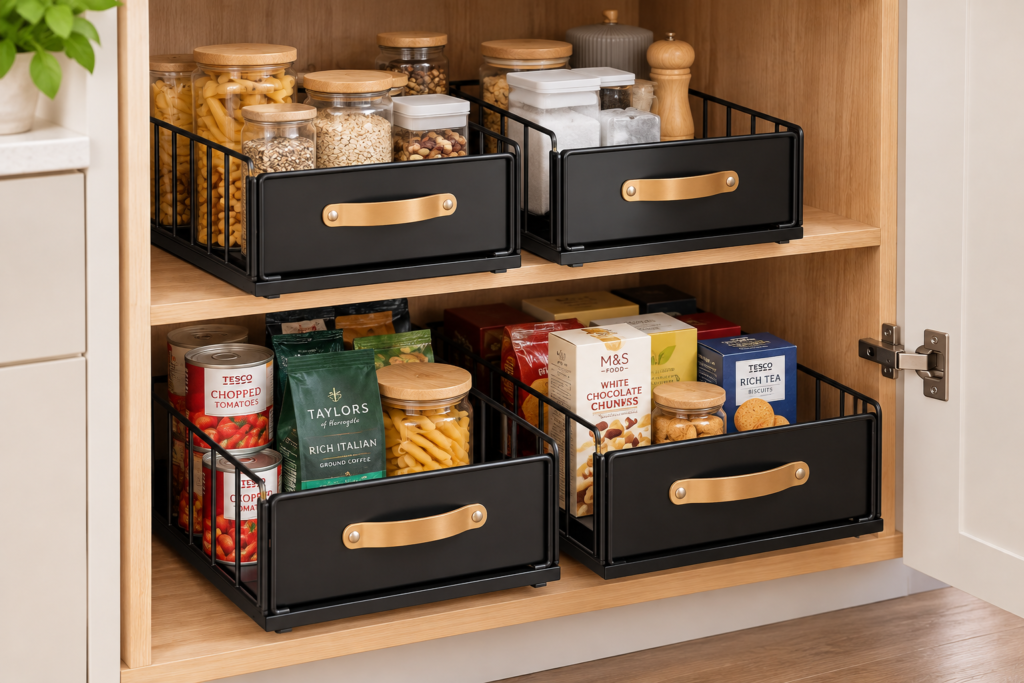
A practical pull-out cupboard option
Kitstorack Heavy Duty Pull Out Cabinet Organiser
This sliding basket brings stored contents towards the front of a cupboard.
- Product details:
- The Kitstorack Heavy Duty Pull Out Cabinet Organiser uses a sliding metal basket to bring stored items towards the front of the cupboard. The 25 cm version shown measures approximately 40 × 25 × 16 cm and uses an adhesive mounting system rather than requiring screws or drilling. Its open basket design also makes it easier to see what’s stored inside.
8. Add storage beneath an existing shelf
Kitchen cupboards often have unused space immediately beneath their shelves, particularly when smaller tins, jars and packets are stored below. Rather than rearranging the entire cupboard, an under-shelf drawer can turn some of this empty space into useful storage.
This type of organiser works particularly well for smaller items that can otherwise get lost amongst larger packets and containers. Keeping them in a shallow drawer also makes them easier to find without taking up valuable shelf space.
Choose a shallow under-shelf drawer for small loose packets rather than tall jars or mugs. It keeps those contents contained, while an open basket makes them visible without opening anything. Measure the shelf thickness and depth, and check the clearance below for the drawer and its contents. Leave room in front to pull it open. Where clearance is tight, sorting the same packets into an existing box may be simpler than adding a fixed drawer.
Look for:
- A shallow design that doesn’t interfere with items stored below
- Enough clearance for the drawer to open comfortably
- Secure attachment to the underside of the shelf
- A suitable size for packets, stock cubes and other small items
- Dimensions that suit the width and thickness of your cupboard shelf
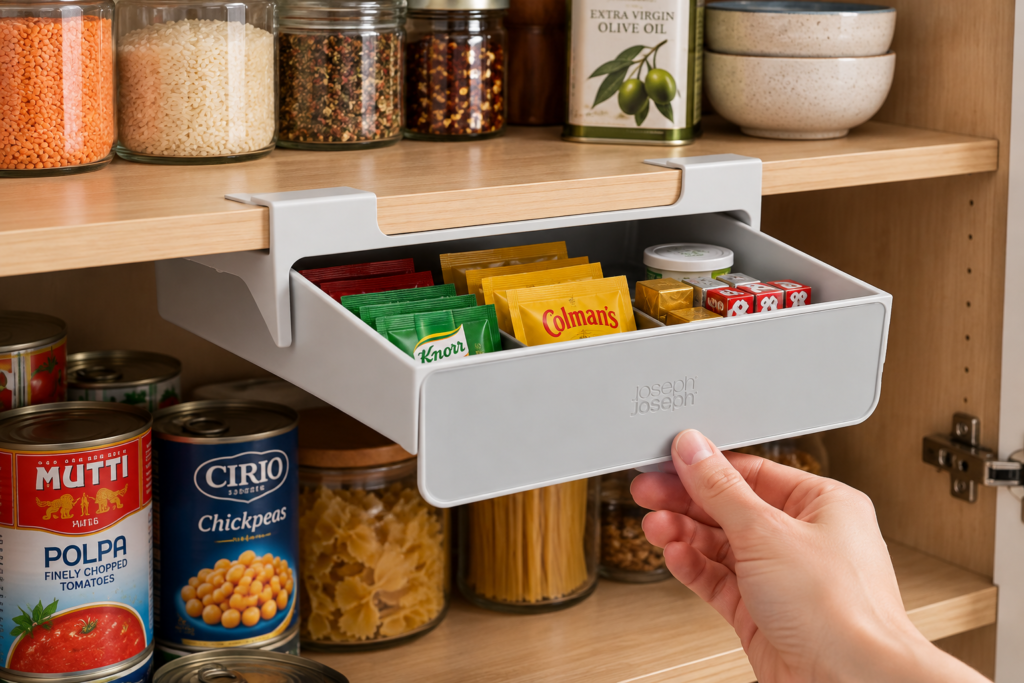
A practical under-shelf storage option
Joseph Joseph CupboardStore Under-Shelf Storage Drawer
A shallow drawer contains stock cubes, seasoning packets and tubes beneath a shelf.
- Product details:
- The Joseph Joseph CupboardStore Under-Shelf Storage Drawer measures approximately 22.5 × 23.5 × 10 cm and attaches beneath a cupboard shelf using adhesive tape, so it doesn’t require drilling or tools. The integrated drawer is designed for smaller kitchen items such as stock cubes, seasoning packets and tubes that might otherwise end up scattered around the cupboard.
It’s also made with a minimum of 50% post-consumer recycled plastic.
9. Use vertical space with a two-tier organiser
Kitchen cupboards often have more height than you actually use, particularly when storing smaller bottles, packets and containers. A two-tier organiser can turn that unused vertical space into an extra level of storage without requiring permanent shelving.
Sliding baskets can also make items at the back easier to reach, so you don’t have to remove everything at the front whenever you need something tucked away behind it. Adjustable designs are particularly useful where you need to accommodate a mixture of taller bottles and smaller items.
A two-tier organiser is most useful when two groups of items need separate levels and both levels remain accessible. Before adding one, try adjusting the cupboard’s existing shelf or grouping short items together beneath taller ones. Measure the height of the tallest bottle at each level and allow for the frame and sliding action. Choose this approach instead of several overlapping inserts and baskets, rather than stacking organisers until the cupboard becomes harder to use.
Look for:
- Adjustable height to suit different items
- Sliding baskets for easier access
- A size that fits comfortably inside your cupboard
- Non-slip feet to help keep the organiser stable
- Enough clearance for taller bottles and containers
10. Make deep cupboards easier to access with a turntable
Deep kitchen cupboards can offer plenty of storage, but items pushed towards the back can quickly become difficult to see or reach. A rotating organiser can make better use of this space by bringing bottles, jars and other everyday items to the front without having to remove everything in the way.
Turntables work particularly well for condiments, sauces, oils and jars that would otherwise end up arranged in rows. A raised edge also helps keep taller bottles contained while the tray is being rotated.
A turntable suits a group of smaller bottles or jars you can rotate towards you; a pull-out basket is better when a whole group needs to move out of a deep cupboard. Check the rotating diameter against hinges and neighbouring contents, not just the empty shelf width. Put shorter items where they remain visible and leave room above tall bottles. In a narrow rectangular cupboard, an ordinary labelled tray may use space more efficiently than a circular organiser.
Look for:
- A size that fits comfortably inside your cupboard
- Smooth rotation even when loaded
- A raised edge to help prevent bottles from falling
- A non-slip base or surface
- Enough clearance for taller bottles and jars
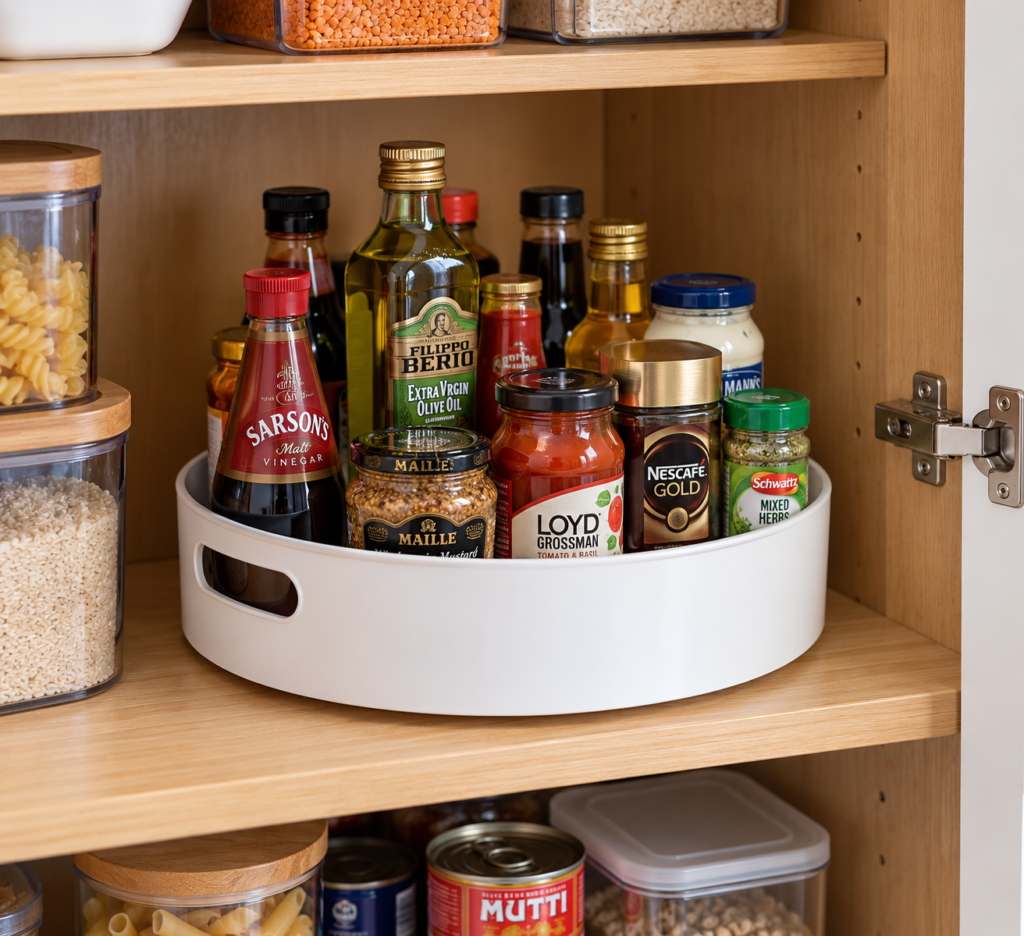
A practical rotating cupboard organiser
Semlos 9-inch Lazy Susan Turntable Cupboard Organiser
A rotating tray brings sauces, oils and smaller jars within reach.
- Product details:
- The Semlos 9-inch Lazy Susan Turntable Cupboard Organiser has a circular rotating tray with raised sides and a non-slip design. At around 23 cm across, it can be used for sauces, oils, condiments, jars and other smaller kitchen essentials while allowing you to rotate the tray to reach items stored at the back.
Making the most of a small kitchen
A small kitchen doesn’t necessarily need more cupboards — sometimes it just needs the space you already have to work a little harder. Shelves, cupboard doors, awkward gaps and unused vertical space can all provide useful extra storage with the right organiser.
You don’t need to tackle everything at once, either. Start with the areas that cause the most frustration, whether that’s a cluttered cupboard, difficult-to-reach items or a worktop that’s constantly running out of space. A few simple changes can make everyday kitchen storage much easier to manage.
The key is to choose storage solutions that suit the space you actually have and the things you use regularly. Measure cupboards and shelves before buying, keep frequently used items within easy reach, and avoid adding organisers simply for the sake of filling every available gap.
With a little planning, even a compact kitchen can feel tidier, more organised and considerably easier to use.
A useful next step