
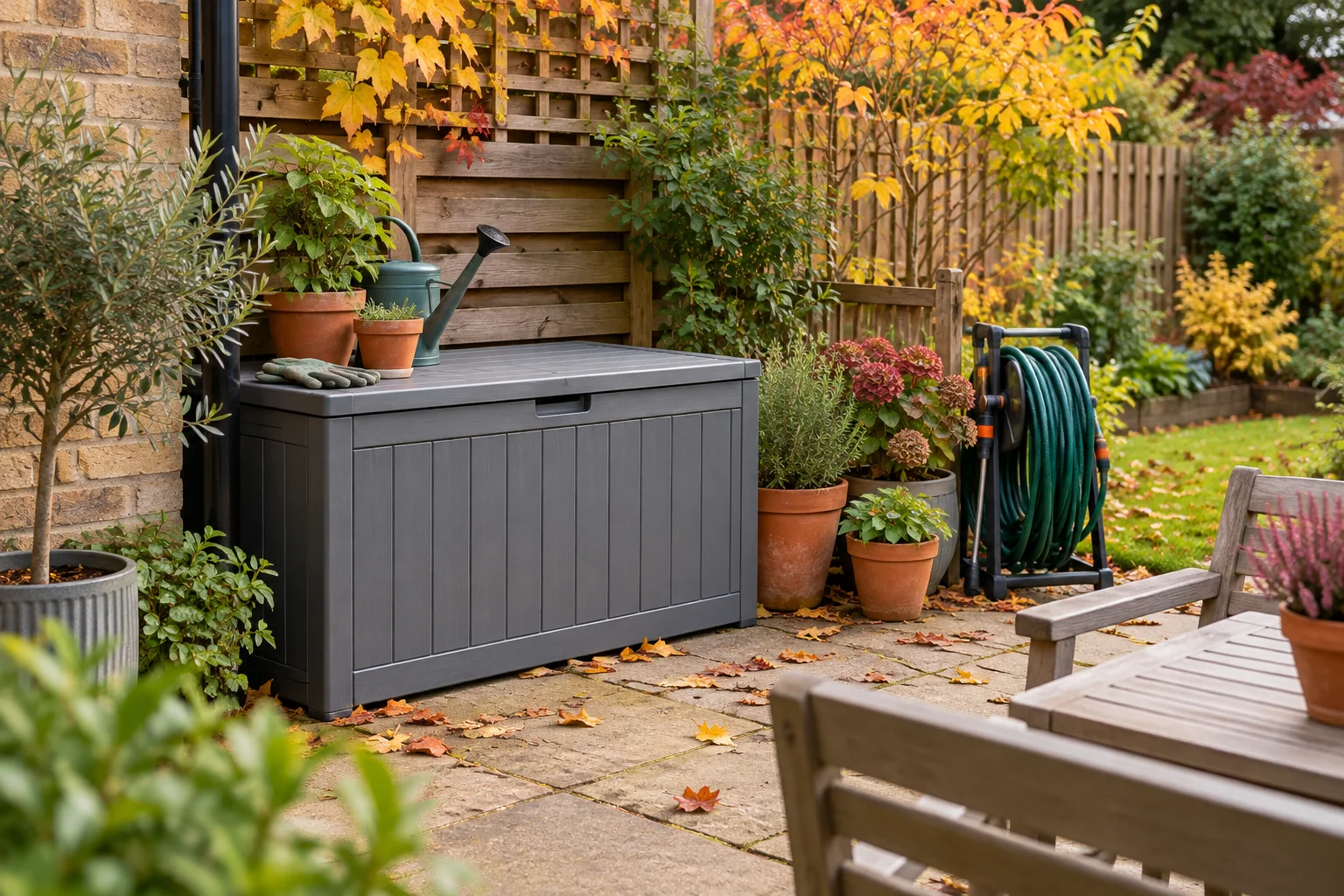
Small Garden Storage Ideas: How to Tidy Up and Prepare for Winter
As autumn arrives and the weather starts to turn, even a small garden can quickly become cluttered with plant pots, gardening tools, hoses and accessories left over from summer. Finding somewhere to put everything isn't always easy, especially if you have a compact patio, a narrow garden or a shed that's already full.
The good news is that getting your outdoor space organised doesn't necessarily mean buying a bigger shed or investing in expensive storage. Often, it's a matter of sorting through what you already have, making better use of available space and choosing practical storage solutions where they're genuinely needed.
In this guide, we'll explore simple ways to tidy a small garden before winter, from organising tools and making use of vertical space to finding compact storage boxes and furniture that serves more than one purpose.
We'll also look at five useful storage options for different spaces and budgets, along with practical tips for keeping your garden equipment clean, accessible and better protected during the colder months.
Affiliate disclosure: This article contains affiliate links. As an Amazon Associate, Cleverly Sorted earns from qualifying purchases, at no extra cost to you.
What we’ll cover
- Start by Sorting What You Already Have
- Choose Compact Storage for a Small Patio or Garden
- Make Better Use of Wall Space in a Small Shed
- Make Use of Vertical Storage When Floor Space Is Limited
- Choose Garden Furniture That Doubles as Storage
- Keep Garden Hoses and Watering Equipment Tidy
- Prepare Your Garden Storage for Winter
1. Start by Sorting What You Already Have
Before investing in garden storage, it's worth taking a little time to see what's actually taking up space.
Small gardens can quickly become crowded with empty plant pots, old compost bags, unused watering cans and tools that have gradually accumulated over the summer. Simply clearing out the things you no longer need can make a surprising difference.
Start by gathering together the items you normally leave outdoors or keep in your shed. Then divide them into a few simple groups:
- Keep and use regularly: Everyday gardening tools, watering equipment and accessories you'll still need during autumn and winter.
- Store until spring: Summer accessories, spare plant pots and seasonal equipment that won't be needed for several months.
- Repair or replace: Damaged tools, broken containers or equipment that needs attention before being stored.
- Recycle or dispose of: Empty packaging, unusable items and anything you're unlikely to need again.
Make Better Use of the Space You Already Have
Once you've sorted everything, think about where each group could go.
Stacking clean, empty plant pots can free up valuable floor space. Smaller accessories such as plant labels, garden ties and seed trays can be grouped in containers you already own.
If you have a shed, consider whether existing shelves or hooks could be used more effectively before buying additional storage.
It's also worth keeping the things you use most often within easy reach. There's little benefit in creating a beautifully organised shed if you have to move several boxes every time you need a pair of secateurs.
Think About Winter Conditions
Before putting anything away for several months, make sure it's clean and dry.
Brush soil from gardening tools, allow damp equipment to dry properly and follow the manufacturer's storage recommendations for anything that could be damaged by frost or moisture.
Remember that a storage box described as weather-resistant isn't necessarily completely waterproof. Items that are particularly vulnerable to damp may need to be stored somewhere more sheltered.
A good clear-out is often the most effective first step towards a tidier garden — and it costs nothing.
2. Choose Compact Storage for a Small Patio or Garden
If you don't have a shed, finding somewhere to keep everyday garden accessories can be a challenge.
Plant pots, gardening gloves, small hand tools and watering accessories can quickly make a patio feel cluttered, particularly when everything is left out over winter.
A compact outdoor storage box can help keep these items together without taking up as much room as a full-sized garden storage unit.
A Practical Option: Keter City 113L Outdoor Storage Box
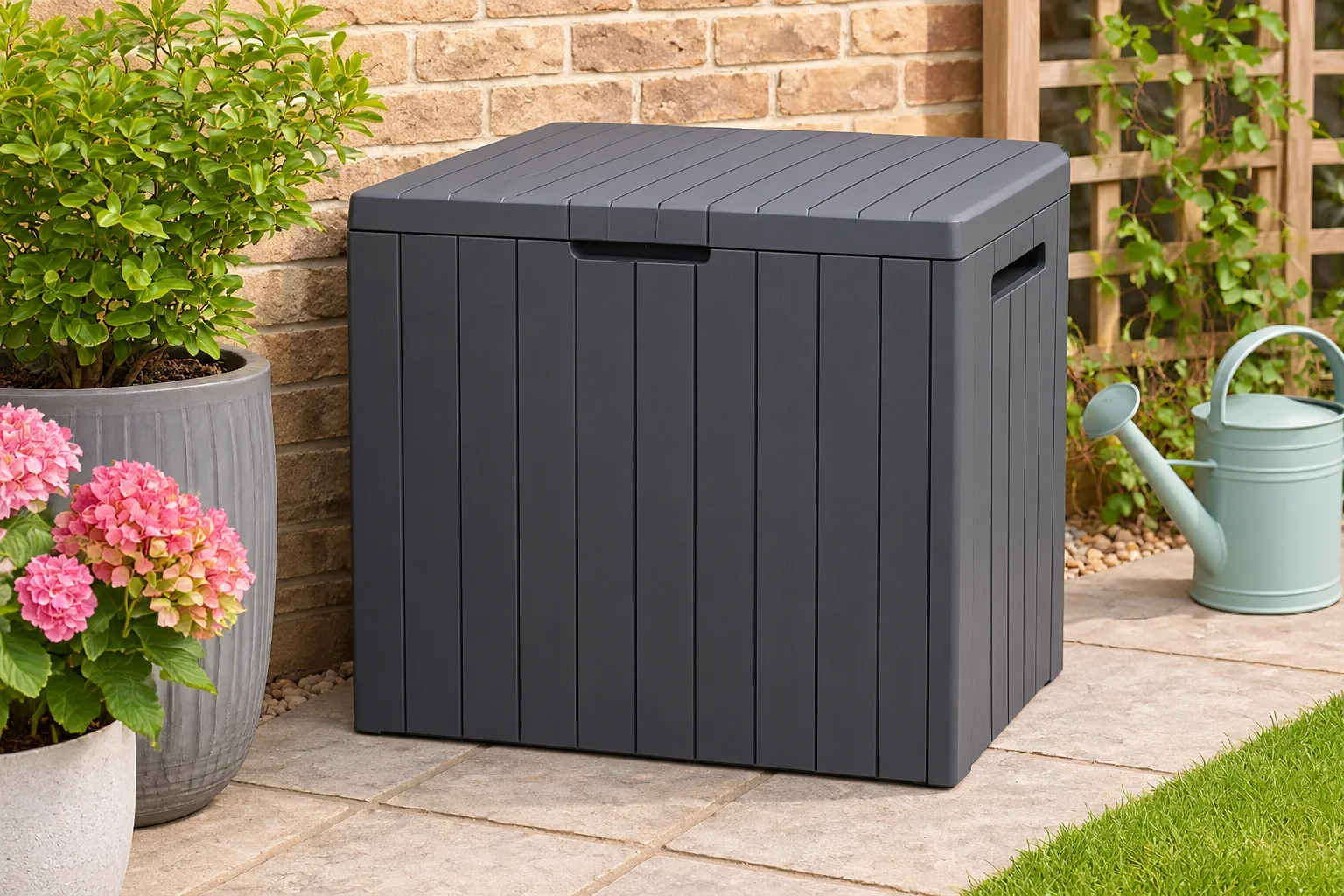
The Keter City 113L Outdoor Storage Box is a relatively small, grey, wood-effect storage box designed for balconies, patios and compact gardens.
With a capacity of 113 litres and external dimensions of approximately 58 cm wide, 44 cm deep and 55 cm high, it could be a useful option where floor space is limited.
Its weather-resistant resin construction is designed for outdoor use, while the hinged lid provides access to the contents. Keter also advertises straightforward assembly without the need for specialist tools.
For a small garden, it could be useful for storing:
- Gardening gloves and small hand tools.
- Empty plant pots and lightweight accessories.
- Garden ties, plant labels and other seasonal supplies.
- Outdoor toys and accessories that are suitable for this type of storage.
The box can also serve as a small outdoor side table, helping it make better use of limited patio space.
Before buying: Measure the intended location and allow enough room to open the lid fully. Remember that 113 litres is a relatively modest capacity, so this isn't a substitute for a shed if you need to store larger equipment.
Although the box is described as weather-resistant, it shouldn't be treated as completely waterproof. For autumn and winter storage, avoid leaving fabric cushions, electrical items or anything particularly vulnerable to damp inside for extended periods.
For a small patio or garden without a shed, a compact storage box can be a straightforward way to keep everyday accessories together while leaving more of your outdoor space clear.
3. Make Better Use of Wall Space in a Small Shed
If you have a small garden shed, you'll know how quickly the floor can disappear beneath spades, rakes, forks and other gardening equipment.
Long-handled tools are particularly awkward to store. Leaning them against a wall might seem convenient, but they can easily fall over or become tangled together when you're trying to reach something at the back.
One simple way to create more usable space is to move suitable tools off the floor and onto the shed walls.
A Practical Option: zacurter Wall-Mounted Garden Tool Rack
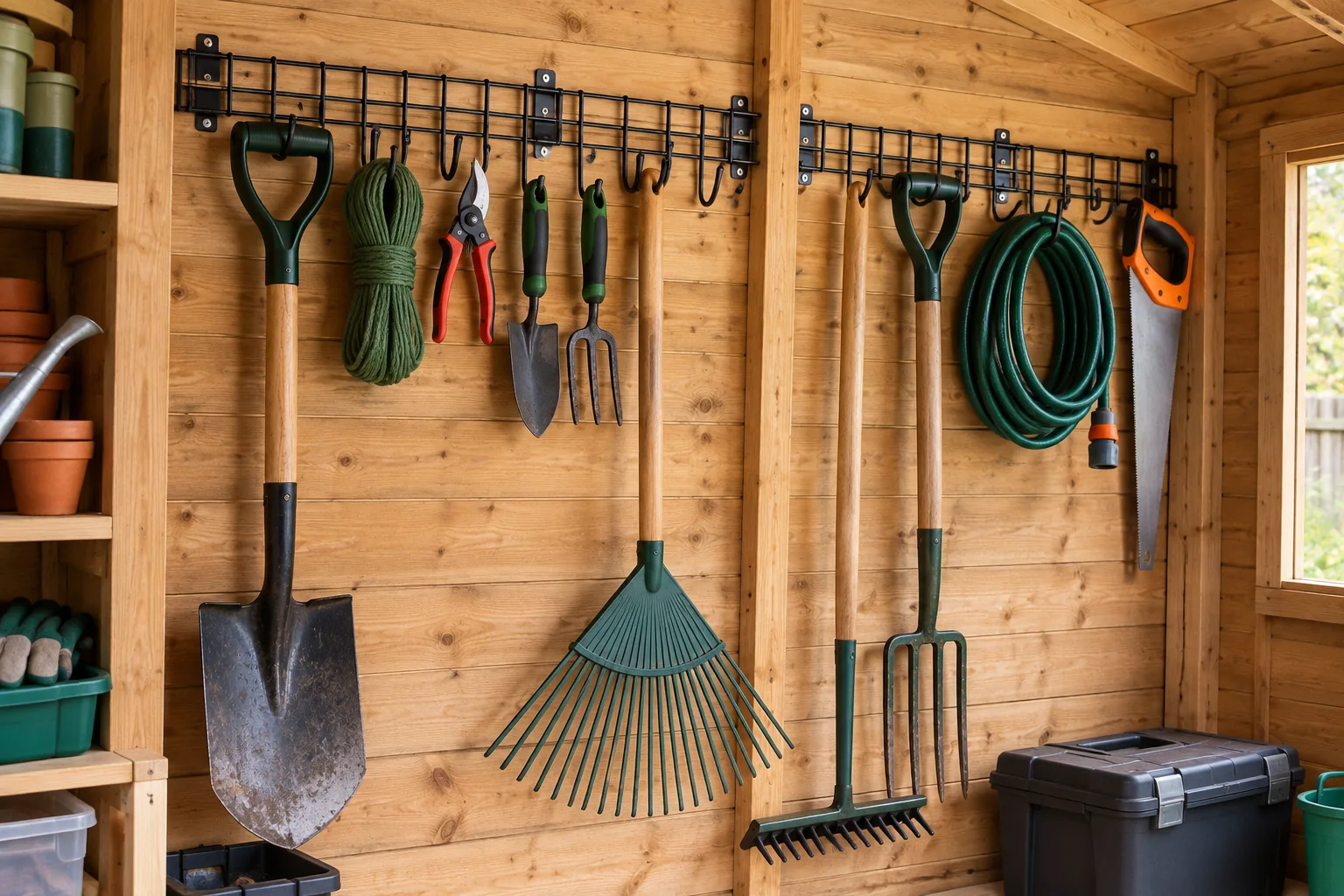
The zacurter Garden Tool Rack is a metal wall-mounted organiser designed to hold a variety of garden tools and accessories.
The selected J-tool rack version comes with four rail sections, each approximately 40.6 cm (16 inches) long, providing a combined length of around 160 cm when arranged end to end.
It includes adjustable hooks that can be positioned to suit different tools, making it a flexible option for organising a cramped shed.
Depending on your equipment and the available space, it could help you store:
- Spades, forks and garden rakes.
- Brooms and other long-handled tools.
- Hand trowels, small forks and secateurs.
- Garden rope and lightweight accessories.
- Suitable watering equipment and hose accessories.
Because the rail sections can be installed separately, you don't necessarily need one long, uninterrupted wall. You could position them around existing shelves or other fixtures, provided each section is securely mounted.
Before installing: Check the wall construction carefully. Some garden sheds have relatively thin timber panels that may not support a heavily loaded rack without additional reinforcement.
The manufacturer supplies mounting accessories, but you'll still need to make sure the fixings are suitable for your particular wall. Heavy tools should be supported securely, with enough clearance to remove them safely.
It's also worth checking that hanging tools won't obstruct the shed door or narrow walkways.
Wall-mounted storage won't increase the actual size of your shed, but it can make a surprisingly big difference to how much usable floor space you have.
Keeping tools visible and organised also means you're less likely to waste time searching through a pile of equipment whenever you need something.
4. Make Use of Vertical Storage When Floor Space Is Limited
Not every garden has enough room for a traditional shed. If you have a narrow patio, a small courtyard or only a limited amount of space beside the house, a full-sized storage building might simply be impractical.
In these situations, choosing storage that makes better use of height rather than width can be a sensible alternative.
A tall, narrow garden cabinet or mini shed can provide somewhere to keep tools, plant pots and other gardening accessories without occupying a large area of valuable outdoor space.
A Practical Option: CHRISTOW Narrow Garden Shed with 3 Shelves
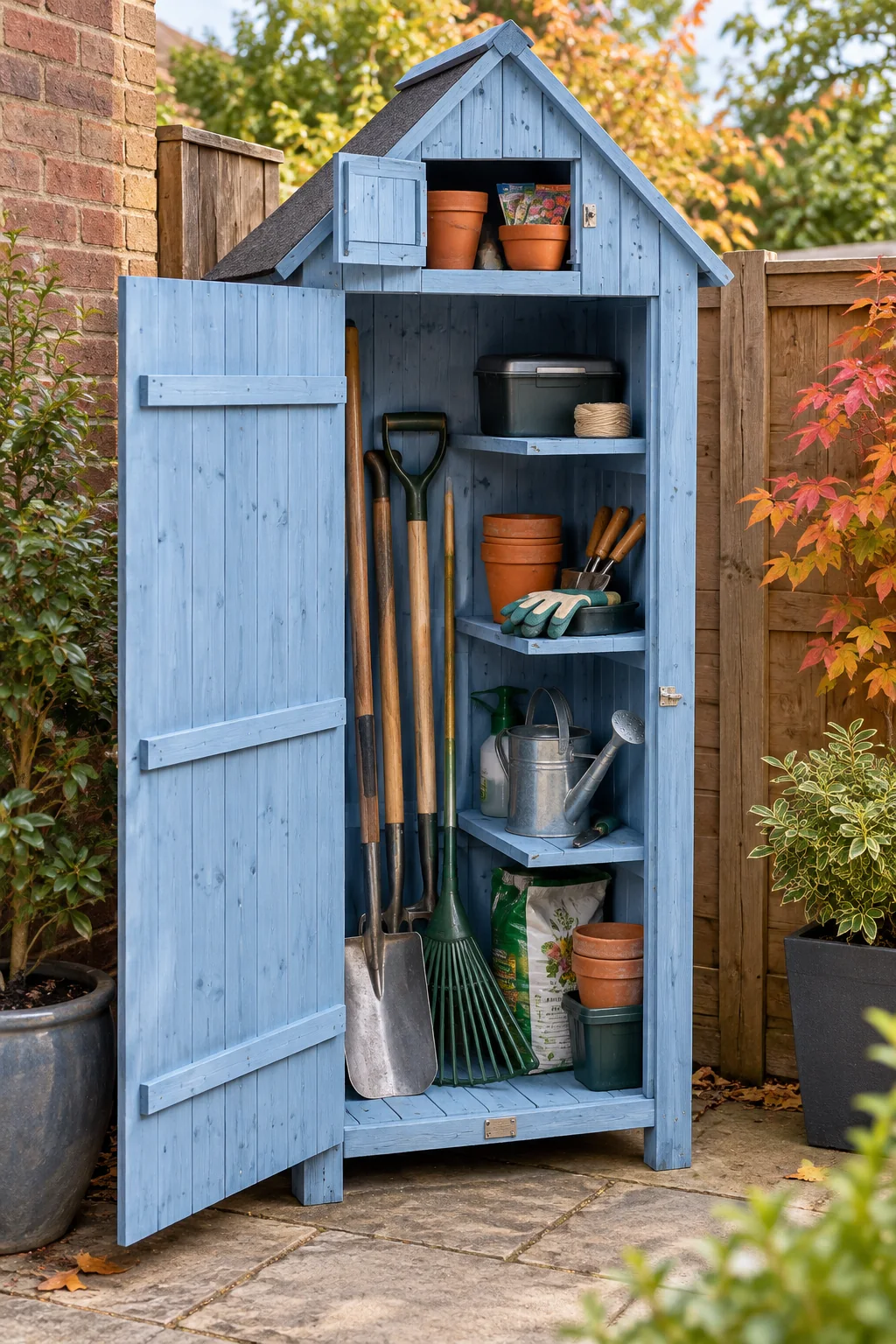
The CHRISTOW Narrow Garden Shed is a compact wooden storage unit designed for gardens where space is limited.
The selected blue version measures approximately 178.5 cm high, 78 cm wide and 51.5 cm deep, including the roof overhang.
Its tall design provides a combination of open vertical storage and shelving, making it potentially useful for keeping different types of gardening equipment organised.
The shed includes:
- Three internal shelves for smaller gardening accessories.
- A full-height storage area for taller items such as a spade or rake.
- A small roof-hatch compartment for additional storage.
- A full-height door with a barrel bolt, which can be secured with a separate padlock.
- Pre-treated wooden construction with a felt-covered roof.
For a smaller garden, this type of storage could help keep frequently used tools and accessories together without needing a conventional shed.
What to Consider Before Buying
This is a more substantial purchase than a basic storage box, so it's worth checking that the layout genuinely suits your needs.
Although the shed is narrow, you'll still need a suitable level position, enough room to open the door and access to the roof hatch.
The timber is supplied pre-treated, but that doesn't mean it can be left without maintenance. The manufacturer recommends applying a suitable waterproof paint or wood preservative within a year to help protect against damp, rot and insects.
It's also important not to assume that a wooden shed will keep everything completely dry throughout winter. Items that are particularly vulnerable to moisture may need additional protection or indoor storage.
Assembly is required, and the unit should be positioned and secured according to the manufacturer's instructions, particularly in exposed or windy locations.
For a garden where every centimetre of floor space matters, a tall storage unit like this could offer a practical compromise between a small storage box and a conventional shed.
The main advantage is being able to organise smaller items on shelves while still leaving room for longer gardening tools.
5. Choose Garden Furniture That Doubles as Storage
In a small garden, every piece of furniture takes up valuable space. If you have a compact patio or courtyard, finding room for both seating and outdoor storage can be particularly difficult.
One way to make better use of the available space is to choose furniture that serves more than one purpose.
A garden storage bench, for example, provides somewhere to sit while also offering a compartment for keeping suitable outdoor accessories neatly out of sight.
This can be especially useful if you enjoy sitting outside during the warmer months but don't have room for a separate storage box.
A Practical Option: Keter Eden 265L Garden Storage Bench
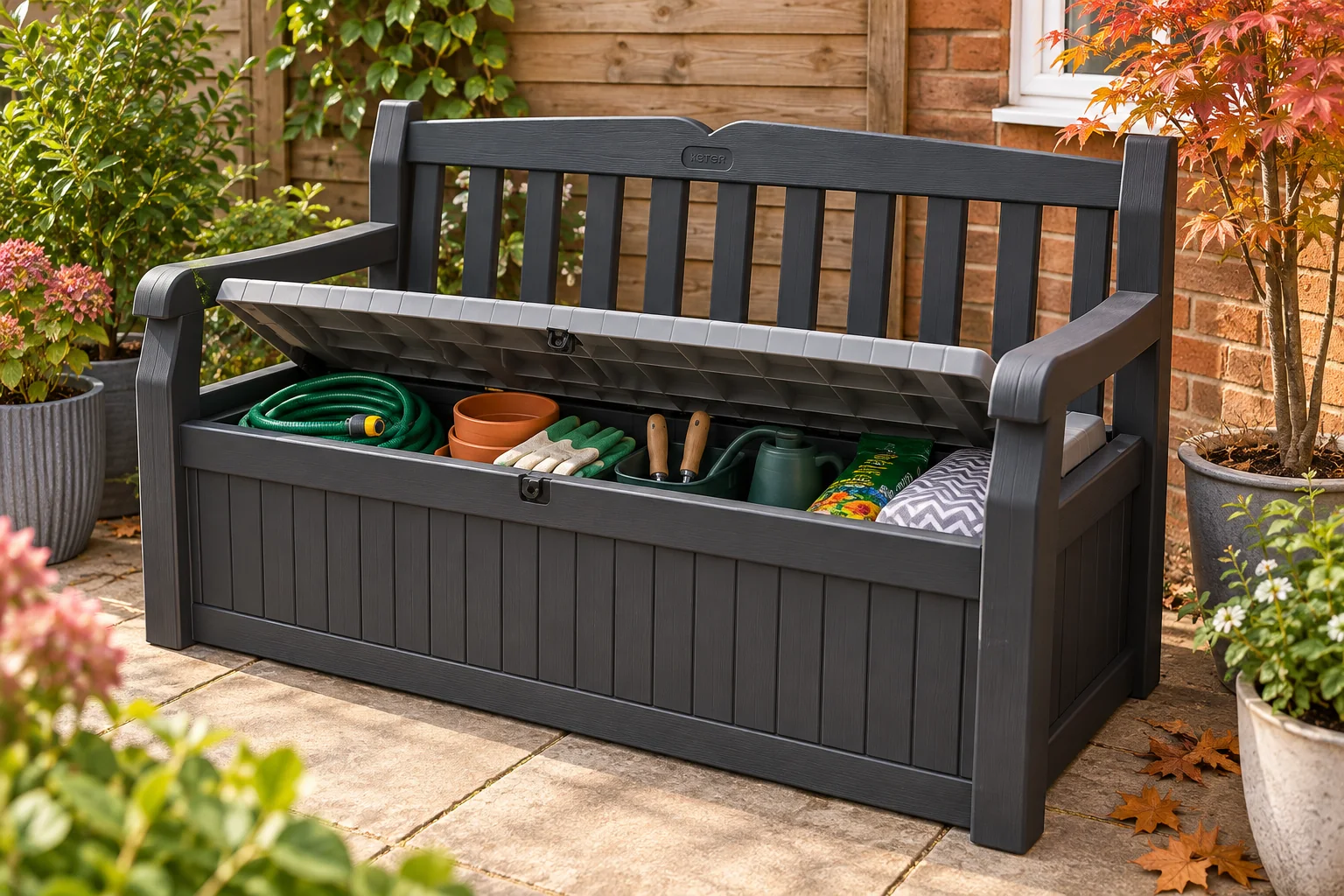
The Keter Eden 265L Garden Storage Bench combines a traditional two-seater garden bench with a storage compartment beneath its lift-up seat.
The selected graphite and light-grey version has a slatted backrest, armrests and a wood-effect design made from weather-resistant resin.
With a storage capacity of 265 litres, it offers considerably more room than the compact Keter City box featured earlier in this guide.
Depending on the size and shape of your belongings, the storage compartment could be useful for:
- Small gardening tools and accessories.
- Outdoor toys and garden games.
- Lightweight patio accessories.
- Suitable seasonal garden supplies.
- Garden cushions during short periods of dry-weather storage, provided they are removed when necessary.
The bench is designed to seat two adults, making it a practical option for a small seating area where a separate storage unit might otherwise take up too much room.
The manufacturer also describes the resin construction as weather-resistant and low-maintenance, avoiding the regular painting or staining typically associated with wooden garden furniture.
What to Consider Before Buying
Although a storage bench combines two functions, it still needs enough room to be used comfortably.
Before purchasing, measure the intended location and allow space to sit down, walk around the bench and lift the seat fully to access the storage compartment.
The storage area is useful for suitable outdoor accessories, but don't assume it will keep everything completely dry throughout winter.
In particular, fabric cushions and other moisture-sensitive items are generally better stored somewhere dry and sheltered during prolonged wet or freezing weather.
The bench requires assembly, and its lockable feature should be treated as a useful deterrent rather than a guarantee against theft.
For a small patio where seating is already part of your plans, a storage bench could be a sensible alternative to buying a separate garden seat and storage box.
The key is choosing furniture you'll genuinely use, rather than adding another large item to an already crowded outdoor space.
6. Keep Garden Hoses and Watering Equipment Tidy
Garden hoses have a habit of taking up more space than you'd expect, especially in a small garden or patio.
When left on the ground, a hose can become tangled around plant pots, collect dirt or create an obstacle across a narrow path. And once autumn arrives, it's easy to forget about watering equipment until the first frost.
A simple wall-mounted holder can help keep your hose neatly stored and free up valuable floor space.
A Practical Option: Josmimic Metal Wall Garden Hose Holder
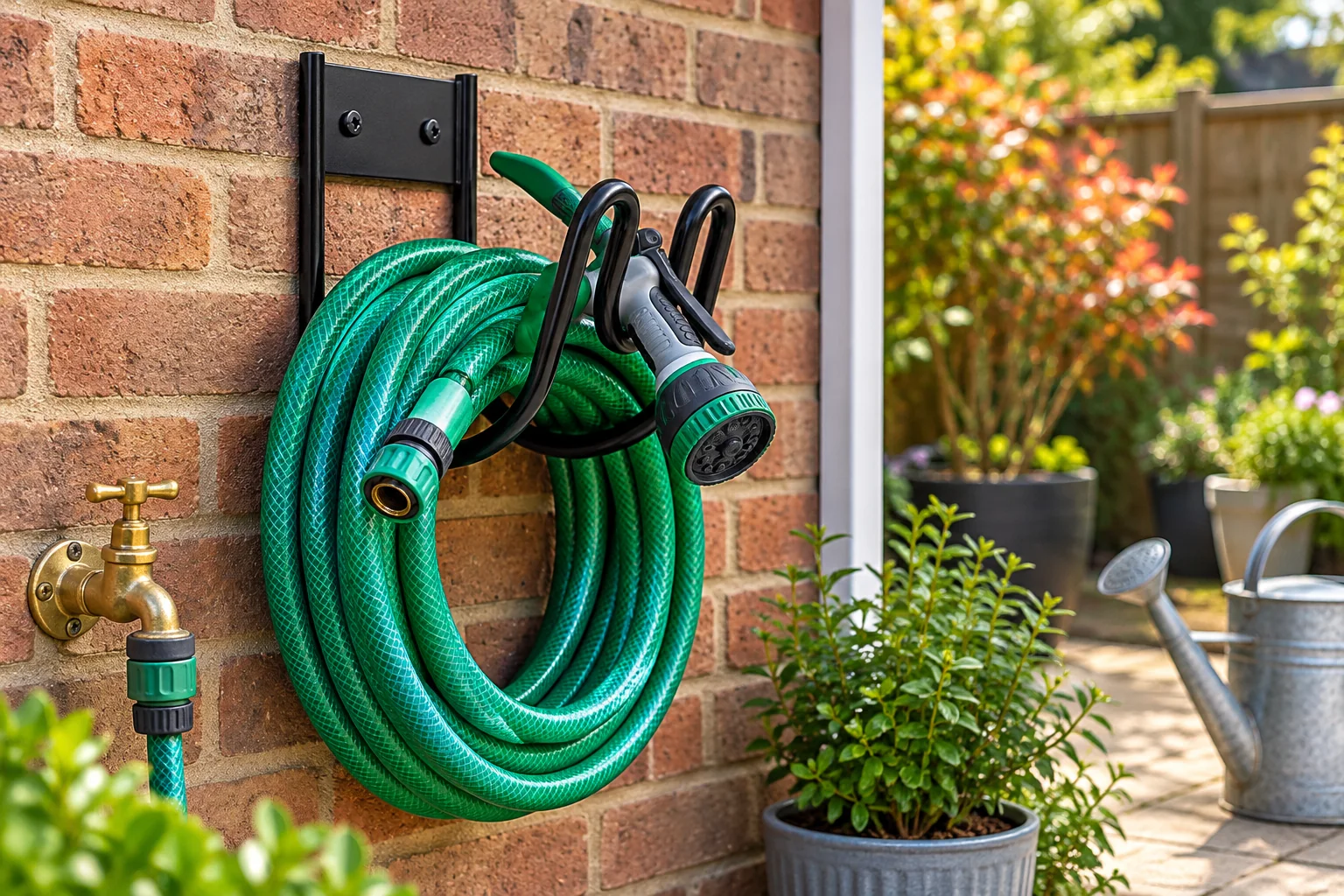
The Josmimic Metal Wall Garden Hose Holder is a black, wall-mounted organiser designed to support a coiled garden hose.
Made from coated alloy steel, it features a curved double-hook design with a smaller upper section intended to provide a convenient place for the hose nozzle.
Unlike a traditional hose reel, there's no winding mechanism. You simply coil the hose by hand and hang it over the holder.
For a smaller garden, this could be useful for:
- Keeping a garden hose off the patio or lawn.
- Reducing tangles and making the hose easier to find.
- Freeing up space around plant pots and garden furniture.
- Organising suitable watering equipment on a shed or garage wall.
The selected version includes one holder, along with screws and wall anchors for installation.
Choose a Suitable Mounting Position
Before installing the holder, consider where you normally use and store your hose.
A wall close to the outdoor tap may be convenient during the warmer months, while a sheltered shed or garage wall could be more suitable for longer-term storage.
Make sure the mounting surface is strong enough to support the combined weight of the holder and hose. A long hose can become surprisingly heavy, particularly if water remains inside it.
The supplied fixings may not be suitable for every wall type, so check the manufacturer's installation guidance before drilling.
Don't Forget to Prepare Your Hose for Winter
Although the holder is designed for outdoor use, hanging a hose on the wall won't protect it from freezing temperatures.
Before prolonged freezing weather:
- Disconnect the hose from the outdoor tap.
- Drain out as much remaining water as possible.
- Coil it loosely, avoiding sharp bends or kinks.
- Store it somewhere sheltered and frost-free where practical.
- Follow the hose manufacturer's winter storage recommendations.
Water left inside a hose can freeze and expand, potentially damaging the hose or its fittings.
A wall-mounted hose holder is a relatively simple storage solution, but it can make a noticeable difference to a small patio or shed.
Combined with a little winter preparation, it helps keep watering equipment organised and ready for use when spring returns.
7. Prepare Your Garden Storage for Winter
Once you've organised your garden tools and accessories, it's worth spending a little time making sure everything is ready for the colder months.
Autumn and winter can be particularly hard on outdoor equipment. Persistent rain, damp conditions and freezing temperatures can damage items that have been left outside or stored without proper preparation.
Fortunately, a few simple steps can help keep your belongings in better condition until spring.
Clean and Dry Gardening Tools
Before putting tools away for winter, remove any soil, grass or plant debris.
Use a stiff brush to clean spades, forks and hand tools, then allow them to dry thoroughly. Metal tools may benefit from a light application of suitable protective oil, following the manufacturer's guidance.
Check wooden handles for cracks or splinters and deal with any damage before storing the tools.
Where possible, hang tools securely or keep them in a dry, organised location rather than leaving them directly on a damp shed floor.
Organise Pots and Small Accessories
Empty plant pots can quickly accumulate around a small garden.
Clean reusable pots, allow them to dry and stack them where their shape and material allow. Group smaller accessories such as plant labels, garden ties and seed trays in containers you already own.
Avoid stacking heavy or fragile pots too high, particularly where they could fall or become damaged.
If you're storing terracotta pots, remember that moisture trapped inside them can freeze and expand, potentially causing cracks. Keeping them clean, dry and sheltered can help reduce the risk.
Protect Items from Damp
Even a well-organised garden shed can develop condensation during colder weather.
Check stored belongings occasionally for signs of moisture, mould or water getting inside.
Avoid placing cardboard boxes directly on damp floors, and consider using existing shelves to keep suitable items raised.
For outdoor storage boxes and benches, follow the manufacturer's guidance and remember that weather-resistant construction doesn't necessarily guarantee a completely dry interior.
Fabric cushions, electrical equipment and other moisture-sensitive belongings are generally better kept in a dry indoor location during prolonged wet weather.
Check Your Storage Before Bad Weather
Before winter sets in, take a few minutes to inspect your storage arrangements.
Make sure:
- Storage boxes and shed doors close properly.
- Hinges, catches and locks work as intended.
- Wall-mounted racks and hooks remain securely fixed.
- Tall storage units are positioned and secured appropriately.
- Garden hoses have been disconnected and drained before freezing conditions.
- Frequently needed tools remain easy to access.
If you have a wooden shed, check for any maintenance recommended by the manufacturer, including the condition of roof coverings and protective timber treatments.
The aim isn't simply to hide everything away until spring. It's to make sure your garden equipment is clean, safely stored and ready to use again when the warmer weather returns.
Final Thoughts: A Tidier Garden Ready for Winter
Preparing a small garden for winter doesn't have to mean buying a bigger shed or filling every available corner with storage containers.
Often, the biggest improvement comes from sorting through what you already own, clearing away unused accessories and making better use of the space you have.
A compact storage box might be enough for a small patio, while wall-mounted racks can help free up valuable shed floor space. If you need something more substantial, a tall, narrow storage unit could be worth considering. And where seating is already part of your plans, a storage bench can provide two useful functions in one piece of furniture.
You don't need all of these solutions. The best approach is to choose storage that suits your garden, the equipment you actually use and the space available.
Before winter arrives, take a little time to clean and dry your tools, organise loose accessories and make sure anything vulnerable to damp or frost is stored appropriately.
A well-organised garden isn't necessarily one with lots of storage. It's one where everything has a sensible place, leaving you with more room to enjoy your outdoor space when spring returns.